


Author: Kathleen Curtis


 Expertise: Graduate EducationCareer DevelopmentFinancial Aid
Editor: Kristin Marino

Reviewer: Jamie Nelson

- GMAT Comparison
The New GMAT vs. The Classic GMAT: What Changed?
Read more - New GMAT
The New GMAT at a Glance: FAQs, Sections, and Structure
Read more - Study Timeline
Mapping Out Your GMAT Study Timeline
Read more - Exam Tips
Expert Tips for a 700+ GMAT Score
Read more - Sample Q&As
Getting Familiar with the New GMAT Sections: Sample Questions & Answers
Read more - Expert Interview
Q&A with a GMAT Expert
Read more
The New GMAT vs. The Classic GMAT: What Changed?
While it is possible to find an MBA program with no GMAT requirement, a high GMAT score can be critical for students looking to attend a top MBA or other business master’s program. A high GMAT score can also be the determining factor in landing financial aid, such as scholarships or grants.
The first step to scoring highly is understanding just how the GMAT has changed, so you can be prepared. Below is a brief overview of the major changes between the new GMAT Focus Edition and the original GMAT Exam. Later, we’ll go into more detail and provide tips on how you can prepare to ace your exam.
| Exam Component | Original GMAT 10th Edition | New GMAT Focus Edition |
|---|---|---|
| Timeframe | 3 hours, 7 minutes | 2 hours, 15 minutes |
| Cost | $275 | $275 (in-person); $300 (online) |
| Number of Sections | 4 | 3 |
| Number of Questions | 80 | 64 |
| Question Formats | Multiple choice; multiple answer; fill in the blank; essay | Multiple choice; multiple answer; fill in the blank |
| Scoring | 200-800 | 205-805 |
| Review Options | None | At the end of each section, test takers can review as many questions in that section as they like but may only edit up to three answers. |
The New GMAT at a Glance: FAQs, Sections, and Structure
If you’re familiar with the old GMAT’s content and structure, then you’re halfway there to knowing how the new GMAT Focus Edition works. However, there are real differences between the old and new GMAT, and it’s critical to gain a clear understanding of the changes to help you earn a top score on exam day. Here’s a look at exactly what the new GMAT Focus Edition is all about.
What are the new GMAT sections?
Below is a detailed description of the three main sections of the GMAT Focus Edition.
Quantitative Reasoning
- Timeframe: 45 minutes
- Number of Questions: 21
- Question Types: Multiple choice
The purpose of the Quantitative Reasoning section is to assess the test taker’s skills in reasoning and logic in the context of problem solving. A foundational knowledge of arithmetic and algebra is also needed, but not directly relied upon in answering these multiple-choice questions.
This is the most math-focused section of the GMAT with questions that touch on probabilities, percents, rates, ratios, exponents, number properties, and other math topics. Use of a calculator is not permitted.
Verbal Reasoning
- Timeframe: 45 minutes
- Number of Questions: 23
- Question Types: Multiple choice; Fill in the blank
The Verbal Reasoning section of the GMAT is designed to assess reading comprehension abilities and reasoning skills as they are applied to given issues and arguments. Questions in the Verbal Reasoning section are broken into two subgroups: Critical Reasoning and Reading Comprehension.
Critical Reasoning questions are designed to measure the test taker’s abilities to make and evaluate arguments and to create and evaluate action plans. Reading Comprehension questions measure the ability to understand words and statements, comprehend logical relationships, follow the development of quantitative concepts, and derive inferences.
Data Insights
- Timeframe: 45 minutes
- Number of Questions: 20
- Question Types: Multiple choice; Multiple answer
Data Insights is the newest section of the GMAT, replacing the old GMAT’s Integrative Reasoning section. The Data Insights section measures the test taker’s ability to comprehend, analyze, and integrate data, and apply that data to practical issues and problems in real-world business settings. Questions in the Data Insights section are divided into five specific problem types:
- Data Sufficiency
- Graphics Interpretation
- Multi-Source Reasoning
- Table Analysis
- Two-Part Analysis
Details for each of these problem types are discussed under the Sample Questions & Answers heading below.
How is the GMAT scored?
The criteria for scoring the GMAT has changed somewhat between the old (10th Edition) and the new Focus Edition. First, the scale range has been modified from 200-800 to 205-805. Each of the three test sections (Quantitative Reasoning, Verbal Reasoning, and Data Insights) accounts for 60 to 90 points of the total score.
What’s important to understand about your number score is that it corresponds to your percentile ranking in how well you performed on the test relative to all other test takers. You can check the current score/percentile concordance on the chart on the GMAC webpage. It’s also important to note that the content scope of the Focus Edition has been narrowed to focus on the specific skills of problem solving, critical thinking, and data literacy. This is to better accommodate changes in diversity of the test-taking population as well as the broader business environment.
What’s a good GMAT score?
Let’s start with the obvious. The higher your score, the better. Just exactly what denotes a “good” score on the GMAT more a term of art.
According to the GMAC, the exam’s sponsor, many test takers of the old (10th Edition) GMAT aimed for a total score of 700. The GMAC additionally states that, “a score of 645 (on the new GMAT Focus) is equivalent to a 700 (on the old GMAT),” as both represent scores in the 89th percentile of their respective editions.
Mapping Out Your GMAT Study Timeline
To earn that high GMAT score you’re after, you’ll need to get cracking on your studies well in advance of the test. Learning the material, identifying test-taking tips, and mastering the format requires months of concerted effort. Below is our recommended six-month preparation schedule for success in taking the GMAT.
Six Months Before GMAT
Register, Research, & Assess
Six months may seem like an eternity to prepare for any test, but investing yourself in this long-term process means you won’t find yourself cramming at the last minute. So, mark your calendar to take care of the following tasks six months before your exam day:
- Register for the GMAT.
You’ll register to take the GMAT on the Graduate Management Admission Council website. The earliest time you can register for your exam is six months prior to your chosen exam date. We recommend you register as soon as you can so that you won’t forget, and you’ll be fully invested in the test prep process. - Research different study methods and materials.
Before launching into a study schedule, it’s important to think about how you learn and what types of study materials work best with your unique study style. For example, some students respond more effectively to visual study materials, while others are more auditory. - GMAT study resources are available in print as well as in several other formats, giving you plenty of options. And if you like studying on the go, there are a number of GMAT prep apps available from Magoosh, Manhattan Prep, Varsity Tutors, and others.
- Assess where you stand with a diagnostic exam.
It’s important to take a practice test early into your studies to get a feel for what you already know and identify areas that could use improvement. When you register for the GMAT, you’ll find that the official starter kit includes two free practice tests. Many test prep companies like Kaplan also provide free practice exams.
Four Months Before the GMAT
Retain a Tutor, Consider Courses, & Reassess
As you get closer to your exam date, you’ll want to seek out additional preparation resources for your existing study plan. Employing the support of a tutor may also be worth the added expense. Here’s a look at those and other options to consider:
- Retain a personal or group tutor.
Working with a GMAT tutor, either one-to-one or in a group setting, can benefit your study process in myriad ways. Tutors are experienced GMAT test takers themselves, so they’re an exceptional resource for obtaining effective insider tips and tricks. And, if you get stuck on a specific problem or concept, a tutor can help you understand the material, move past it more quickly, and keep you motivated. - Consider GMAT prep courses.
If you can afford it, purchasing a full GMAT prep course can be beneficial for exam preparation and resulting test score. GMAT courses vary in cost and length and are available in both in-person and online formats. As for non-paid options, you may be able to find free test prep materials at your local library or community center. Popular online options include, among others, Kaplan, Magoosh, PrepScholar, and the Princeton Review. - Reassess where you stand and adjust your study plan.
After studying for about two months, it’s time to take account of exactly where you are in terms of what you’ve learned and what you need to keep working on. Perhaps, for example, your verbal score has improved but you still need some help on the quantitative section. Taking a second practice exam at this time can help you focus your studying efforts as you head toward the halfway point of your study schedule.
Two Months Before the GMAT
Target Weaknesses & Take Mock Exam
Once you’re two months out from the GMAT, it’s time to get fully in the zone and make the most of your remaining time. That means placing even greater focus on your weaknesses to turn them into strengths before exam day. Here’s how:
- Target your weaknesses with more intensive study.
While you may have identified a weakness in a particular section of the test, now is the time to drill down into the specifics of the problem and address them with targeted study. For instance, you may be strong in reading comprehension but struggle with reasoning. If so, make the conscious effort now to focus on improving your reasoning skills. - Take a timed mock exam.
If you’ve followed our timeline to this point, then you’ve completed at least two practice exams. Now it’s time to take a mock exam. - A mock exam differs from the practice exams in several ways. First, practice exams tend to be shorter and taken in an informal setting. The mock exam, on the other hand, is typically the same length and taken under similar time limitations and conditions as the actual GMAT.
- Mimicking the conditions under which you’ll be taking the GMAT, a mock exam will provide you with a more accurate idea of what to expect and potentially negate any nerves you might experience on your real GMAT exam day.
One Month Before the GMAT
Assess Again, Refine Test-Taking Skills, & Curate Practice Questions
With one month left, it’s time to laser focus your knowledge, address remaining weak points, and get comfortable with the actual test-taking process. You can easily increase your score, maybe substantially, by taking this realistic approach to your last 30 days of preparation.
- Give yourself a final assessment.
For the third and final time, take a practice exam. By benchmarking your progress throughout your months of studying, you’re continually pinpointing weak areas and leaving time to strengthen them. Then, rather than studying for the test as a whole, you can use your last few weeks to focus on those subjects and test-taking skills that still need work. Approaching it from this perspective, you’ll also likely feel less overwhelmed. - Refine your test-taking skills.
Consider in detail specific test-taking skills that will lead to a better score. For instance, you’ll need to practice your pacing skills if you want a shot at answering all questions in each section. Remember, the new GMAT allows you to bookmark and return to rewrite only three questions in each section, so knowing how much time to spend on each individual question is critical.
Curate your practice questions.
Finally, rather than taking another generic practice exam before the big day, now is the time to create a curated test. By approaching your final practice test in this way, you can include only the questions still giving you trouble rather than wasting your time on those that you already have a solid grip on. If time allows, consider creating a couple of different practice tests that zero in on those trouble spots.
GMAT Exam Day
Be Calm & Confident
After preparing for the GMAT for six months, you’ll feel fully confident and ready for the exam. Here are some steps you can take on exam day to reinforce that confidence:
- Double-check your exam time and location.
- Bring a valid photo ID.
- Arrive at least 30 minutes before the test start time to get checked in.
- Make sure you know what you can and cannot bring inside the testing center.
- Take a deep breath and remind yourself of how much hard work you’ve put in.
- Feel proud of yourself!
Expert Tips for a 700+ GMAT Score
The tips below represent the tried-and-true findings of expert tutors and GMAT test takers who’ve performed well on the exam. As you review the following, consider how you can incorporate these tips into your study routine.
Take practice tests early and often.
Test prep and admissions consultant Joa Ahern-Seronde believes in making extensive use of practice tests. Rather than being afraid that they will expose deep gaps in knowledge, think of practice tests as a way to help you pinpoint areas requiring more intensive study.
By taking practice tests frequently, you’ll develop a clear understanding at any given time of how far you’ve come and what you still need to review. “Practice tests provide you with the most data in your journey to a top score,” notes Ahern-Seronde. And by tracking your practice scores along the way, you can feel confidence in what you’ve already accomplished.
Start your prep early.
“Give yourself time to prepare for your first test, and time your first test and the application deadline so that if your first test doesn’t go well, you have time to prepare for the next one,” encourages Arash Fayz, founder of LA Tutors. “If your first test does go well and you don’t need to take a second test, then the time you allocated is just extra time for applications and personal statements.” In short, feeling unnecessarily pressured has never produced the best test results, so give yourself plenty of time to prepare properly.
Don’t underestimate the verbal portion.
“Most people study Verbal far less than they should,” cautions Manhattan Prep teacher Jamie Nelson. Unlike other portions of the GMAT, the Verbal section looks for a different skill set. “Verbal is largely not about finding the correct answer,” she says. “Instead, it is about eliminating four incorrect answers and choosing whatever is left.”
Understand the format.
“The GMAT is its own test with its own format,” says Fayz. “You will need to familiarize yourself with the material and how it’s presented in order to determine what you need to study.” Just because you did well on the SAT, ACT, or GRE doesn’t automatically guarantee that you will ace the GMAT. “While the GMAT draws on material you may have studied in school or while preparing for other tests, that’s not a guarantee of success,” notes Fayz.
Study smarter, not harder.
“Don’t clock study hours just to clock them,” warns Ahern-Seronde. “Make sure you’re studying at times that you’re fresh and ready to go, and don’t push yourself past your retention point.”
It may seem admirable to stay up late every night for months before the exam, but if you don’t study well at night, it’s actually a waste of your time. Rather than telling yourself you have to sit at your desk for a specific number of hours every day, create more concentrated, focused studying sessions. “Take breaks and let your brain process the progress you’re making,” encourages Ahern-Seronde.
Don’t make assumptions.
“Don’t assume which sections need the most prep time based on your academic background,” cautions Fayz. “GMAT math is different than school math or SAT or GRE math, so proficiency in one does not automatically indicate proficiency in the other. The same is true for GMAT verbal sections.” In short, just because you did well in certain subjects in high school or college, or on other exams, doesn’t mean you have the unique skills you’ll need for success on the GMAT.
Approach the quantitative portion smartly.
“In Quants, try to avoid translating word problems into algebraic equations,” suggests Nelson. “Instead, try to either test answers if the answers are whole numbers or make up your own numbers to solve if the answers consist of variables, fractions, or percents.”
It’s also important that you don’t try to do too much in this section. “Choose your battles wisely in Quants, as many question types, such as Rates and Probability, are extremely complicated and time consuming,” notes Nelson. “Guess those quickly and focus on the easier wins.”
Make your data insights efforts count.
The Integrated Reasoning section of the old GMAT has been renamed the Data Insights section. Regardless, Jamie Nelson’s advice regarding the section remains just as relevant. “The Integrated Reasoning section is incredibly time pressured, so the wisest move is only to fully work eight or nine questions,” counsels Nelson. It’s important to note that, unlike other sections of the GMAT, most of the integrated reasoning questions are multi-part in nature, which take more time and create more opportunities for incorrect answers. “If you get one of the sub-questions wrong, you get no credit for the question, so work the question thoroughly or guess it altogether.”
Getting Familiar with the New GMAT Sections: Sample Questions & Answers
As noted, the GMAT has been pared down from four sections to three, with the biggest change being the elimination of the old GMAT’s Analytical Writing Assessment (aka essay) section. Below are examples of questions (and corresponding answers) similar to ones you’ll encounter for each test section of the new GMAT Focus Edition.
Quantitative Reasoning Questions
Problem Solving
All questions in the Quantitative Reasoning section fall under the heading of Problem Solving. Each question begins by posing a problem that requires the test taker to apply basic logic and analytical skills along with basic knowledge in algebra and arithmetic to select the correct answer from among five given choices.
Sample Problem Solving Question
A school is holding a pizza party for the top performers of their most recent standardized test. The distribution of scores is symmetrical about the mean and bell-shaped. The administration determined the invitations will go out to only the students that scored above the standard deviation.
If 68% of the students scored within one standard deviation, what percent of the students will receive an invitation?
- A. 68%
- B. 34%
- C. 32%
- D. 17%
- E. 16%
Answer: E
Source: Test-Guide.com
Verbal Reasoning Questions
Critical Reasoning
Critical Reasoning questions measure the test taker’s skills in evaluating and constructing arguments as well as in creating and evaluating plans of action. Questions typically take the form of short written passages to which test takers are required to select the best answer from five choices. Questions may also require providing a fill-in-the-blank response.
Sample Critical Reasoning Question
Studies reveal that a daily exercise regimen helps stroke survivors regain dexterity in their extremities. Being given an exercise routine and having a consultation with a doctor about the exercise routine have been shown to be effective mechanisms to get patients to exercise daily.
From the above information, which of the following statements can be reasonably inferred?
- A. A stroke survivor that is given a detailed exercise plan and consults her physician about the plan will regain full dexterity in her extremities.
- B. If a stroke survivor is not given an exercise plan and does not consult with a doctor, she will not regain dexterity in her extremities.
- C. Stroke survivors who are given an exercise routine and consult with a doctor about that routine will sometimes regain dexterity in their extremities.
- D. Being given an exercise routine and having a consultation with a doctor about the routine is the best way to help a stroke survivor regain dexterity in their extremities.
- E. Only being given an exercise routine is necessary to regenerate dexterity in the extremities of seniors who have suffered a stroke.
Answer: C
Source: Princeton Review
Data Insights Questions
Data Sufficiency
The purpose of Data Sufficiency questions is to evaluate the test taker’s abilities to comprehend information, discern between relevant and irrelevant information, and determine the sufficiency of that information to resolve a given problem. Each problem begins by posing a question and presenting two statements that include data. Test takers must determine if neither, either, or both statements offer data that is sufficient to answer the given question.
Sample Data Sufficiency Question
In a certain class, a teacher distributed a few candies and a few bars among the students such that each student got an equal number of candies and an equal number of bars, and no candies or bars remained undistributed. How many students were there in the class?
- The teacher distributed 180 candies and 40 bars.
- The total number of items received by each student was less than 20.
- A. Statement (1) ALONE is sufficient, but statement (2) ALONE is not sufficient to answer the question asked.
- B. Statement (2) ALONE is sufficient, but statement (1) ALONE is not sufficient to answer the question asked.
- C. BOTH statements (1) and (2) TOGETHER are sufficient to answer the question asked, but NEITHER statement ALONE is sufficient to answer the question asked.
- D. EACH statement ALONE is sufficient to answer the question asked.
- E. Statements (1) and (2) TOGETHER are NOT sufficient to answer the question asked, and additional data specific to the problem are needed.
Answer: C
Source: Manhattan Review
Graphics Interpretation
Graphics Interpretation questions assess the test taker’s skills for comprehending, interpreting, and evaluating data presented in graphs or related graphical forms such as bar charts, pie charts, scatter plots, x/y graphs, or statistical curve distributions. Test takers are presented with graphs or graphical images along with (in some cases) explanatory text. This is followed by one or more statements for which the test taker must select the most accurate number, word, or phrase.
Sample Graphics Interpretation Question
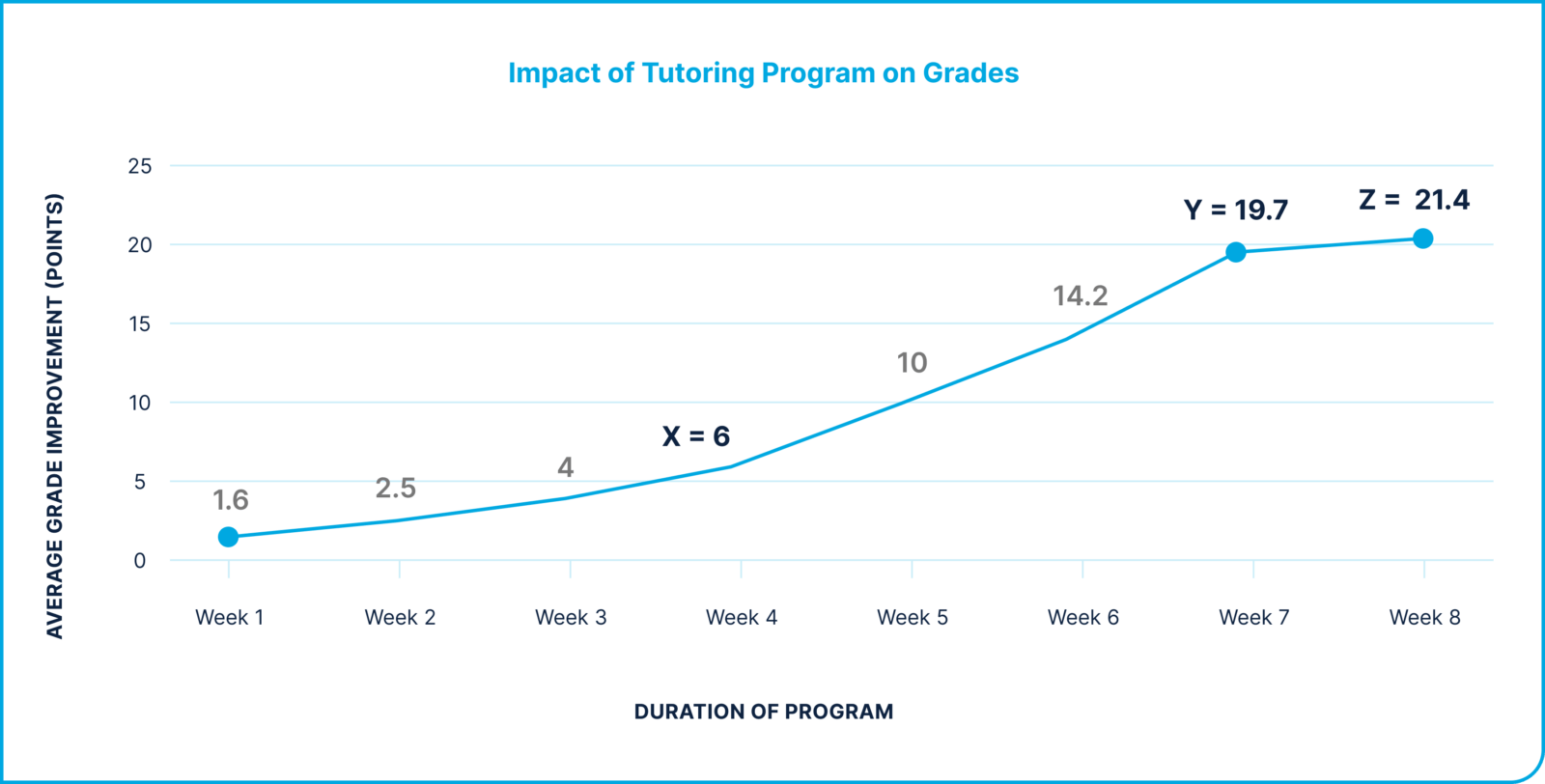
The line graph shows the average increase in algebra grades of students who received below 50% in a placement test and attended an extracurricular math tutoring program for 8 weeks. Points X, Y, and Z represent the average increase in weekly quiz grades for weeks 4, 7, and 8, respectively.
The increase from Week 1 to Week 4 falls approximately between ________.
- A. 4 and 4.6
- B. 3.6 and 4.2
- C. 4.7 and 5.4
Answer: A
Source: Test-Guide.com
Multi-Source Reasoning
Multi-Source Reasoning questions are designed to measure the test taker’s ability to analyze multiple sources of data and determine the correct answers to two-choice true/false, yes/no, etc.) and multiple-choice questions. Data in the form of tables, graphics, and/or text passages is presented on tabbed pages, two or three per problem. Test takers review the data to draw inferences, recognize discrepancies, or determine data relevance.
Sample Multi-Source Reasoning Question
Read each of the following cards:
Card 1
Betty’s Baked Goods operates out of Seattle, Washington. They offer pre-made and DIY baked goods, made from all-natural ingredients, with no preservatives added. All of their products can be packaged into one of five categories:
- 15-piece bite sized pre-made: $28.99 (2.5 pounds*)
- 15-piece bite sized DIY: $24.99 (1.25 pounds*)
- 6-piece full sized pre-made: $49.99 (6 pounds*)
- 6-piece full sized DIY: $39.99 (3 pounds*)
- 6-piece assortment (3 full size pre-made, 3 full size DIY): $45.99 (4.5 pounds*)
Card 2
Betty’s uses two shipping methods, both by Fast Food Shipping: Standard and Special Delivery. Pre-made items must ship through Special Delivery, whereas DIY can ship either.
- Standard Delivery: $10 plus $6/pound
- Special Delivery: $35 plus $10/pound
Card 3
If an order contains items that can be shipped using either service, the customer may choose which shipping method they prefer.
Which of the following is the most likely justification of the difference in the cost of shipping?
- A. The pre-made items weigh more than the DIY items.
- B. The DIY items are dry goods, so they do not need to be refrigerated.
- C. The pre-made items are in higher demand than the DIY items.
- D. DIY items are typically shipped a longer distance than the pre-made items.
- E. The pre-made items are only available seasonally.
Answer: B
Source: Test-Guide.com
Table Analysis
Table Analysis questions present test takers with information in the form of a sortable table similar to a spreadsheet often accompanied by brief text to explain the table or provide additional needed information. Test takers must analyze the information to determine if the given answers are accurate.
Sample Table Analysis Question
The table displays the breakdown of the company’s Advertising Budget for last year.
| Advertising Budget is 15% of Total Budget | ||
|---|---|---|
| Media | Budget (%) | Amount ($Thousands) |
Advertising Budget is 15% of Total
Budget Radio Ads | 11 | 27.5 |
Advertising Budget is 15% of Total
Budget Mailer | 13 | 32.5 |
Advertising Budget is 15% of Total
Budget Internet Ads | 17 | 42.5 |
Advertising Budget is 15% of Total
Budget TV Ads | 24 | 60 |
Advertising Budget is 15% of Total
Budget Newsprint | 19 | 47.5 |
Advertising Budget is 15% of Total
Budget Freestanding | 16 | 40 |
Based on the information given in the table, select all of the statements below that can be proven to be true.
- I. 3.6% of the company’s total budget was set aside for television ads
- II. The company is budgeting for more than $1,600,000 in expenditures.
- III. The company spends more on television ads than they do on print ads.
Answer: Statement I – True; Statement II – True; Statement III – False
Source: True-Guide.com
Two-Part Analysis
Questions in the Two-Part Analysis group measure the test taker’s skills at comprehending and solving complex problems using quantitative reasoning, verbal reasoning, or a combination of both. Test takers are given a written problem or scenario and required to make two related choices in a two-step process from answers presented in a table format.
Sample Two-Part Analysis Question
Organization A currently has 1,050 members. Organization B currently has 1,550 members. The number of members of Organization A and the number of members of Organization B are increasing annually, each at its own constant rate. Analysts project that if each of these organizations maintains its constant annual rate of membership increase, five years from now they will for the first time have the same number of members, and in subsequent years Organization A will have more members than Organization B.
In the table below, identify a rate of increase, in members per year, for Organization A and a rate of increase, in members per year, in Organization B that together are consistent with the analysts’ projection. Make only one selection in each column.
| Organization A | Organization B | Rate of Increase (members per year) |
|---|---|---|
Organization A ○ | Organization B ○ | Rate of Increase (members per year) 10 |
Organization A ○ | Organization B ○ | Rate of Increase (members per year) 30 |
Organization A ○ | Organization B ○ | Rate of Increase (members per year) 40 |
Organization A ○ | Organization B ○ | Rate of Increase (members per year) 120 |
Organization A ○ | Organization B ○ | Rate of Increase (members per year) 130 |
Organization A ○ | Organization B ○ | Rate of Increase (members per year) 150 |
Answers: Organization A – 130; Organization B – 30
Source: GMAC
Q&A with a GMAT Expert
Q. What is the biggest/most common mistake students make in preparing for the GMAT?
A: One of the most impactful mistakes is not working to develop time discipline during your studies. Poor use of time on the test is the number-one reason students score below where they could on the GMAT, and for many the tight time on the test is a very rude awakening.
Particularly when completing the Quant section, the average test taker will not have enough time to fully work every question and will have to work some and strategically guess others. It is very important to practice timed tests so that you are ready to make the decision to either work a question or guess it quickly on test day. Many test takers take too much time early on then run out of time at the end, causing their score to plummet.
Q. In your estimation, which section is the trickiest and how can students prepare for it?
A: Within the Quant section, about 40% of the questions are Data Sufficiency, a question type unique to the GMAT. Data Sufficiency does not involve solving a question and determining an answer; rather, it requires you to take a question and evaluate two pieces of data as to whether they are sufficient to answer the question. Preparing involves learning to break down the question, as it can often be manipulated and rewritten as a simpler question, and realizing that when it cannot the best strategy is often to test cases using the criteria in the statements.
Q. What are your favorite prep resources for the GMAT and where can students turn for help?
A: Two terrific resources are the All the Quant and All the Verbal books published by Manhattan Prep, which outline necessary memorization work and helpful strategies. Finally, you are very welcome to visit the Manhattan Prep forum, where you can receive free custom advice from top GMAT instructors.
Q. What should students keep in mind when awaiting their scores?
A: Other than the essay score, which can take a few weeks to receive, you will know your scores upon finishing the exam. So there’s really not much waiting these days.
Q. What advice do you have for students who need to retake the GMAT?
A: First, do your homework and make sure that a retake is necessary. I often have students tell me that they must have a particular score because they read that it’s the average at their desired school, yet they end up being admitted to strong programs with the score that they already have.
If a retake is necessary, plan out the amount of time that you will need to study. If you need to improve 30 points that may be achievable in a month, but 100+ points may take three-four months. Start by taking a practice test that will allow you to run analytics to evaluate your pockets of weakness.
Our free test at Manhattan Prep will guide you through generating an assessment report that will show you exactly where you need to improve. Finally, obtain resources to help you learn not only content but strategy, and assess your progress every two to three weeks by taking practice tests.